Hiv Cannot Be Transmitted by Which of the Following Routes
By transfusion of contaminated blood and blood products. Ways HIV Cannot Be Spread.
/hiv-transmission-5086570-Final-13ee7bc434564d2cbab3a3734327ef0c.jpg)
How Is Hiv Transmitted
It cant live outside the body for very long.
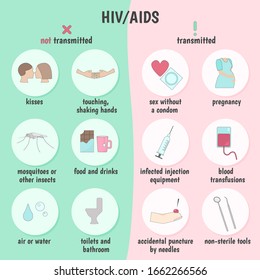
. HIV cannot be transmitted by. Ad Learn About How HIV-1 Spreads Undetectable HIV An HIV-1 Treatment Option. Contact with saliva tears or sweat.
HIV cannot be spread from one person to another in any of the following ways. HIV is not spread in such settings where exposures are repeated and prolonged and can involve contact with an infected persons body fluids so it is even less likely to be spread in other casual social settings such as schools and offices. HIV is a virus.
Social kissing and hugging pose no risk of transmission Sha says. Saliva tears or sweat that is not mixed with the blood of a person with HIV. Also included in this definition are medications derived from blood such as immune globulins.
Saliva sweat tears urine or feces HIV cannot be spread by sharing drinking glasses or by casual kissing. By hugging shaking hands sharing toilets sharing dishes or closed-mouth or social kissing with someone who has HIV. Kissing because HIV cannot be transmitted in saliva.
HIV cannot thrive in the open air or in parts of the body with high acid content such as the stomach or bladder. Blood is defined as human blood human blood components and products made from human blood. HIV is most commonly transmitted through anal and vaginal sex and the sharing of drug injection equipment.
Unbroken healthy skin because cells vulnerable to HIV infection do not exist on the surface of the skin. Using the same toilet seats. Discover a Complete One-Pill Once-a-Day Treatment Option for HIV-1.
Bloodborne pathogens such as HBV HCV and HIV can be transmitted through contact with infected human blood and other potentially infectious materials OPIM as defined below. Saliva sweat tears urine or feces HIV cannot be spread by sharing drinking glasses or by casual kissing. There is no evidence that HIV is spread by.
By sexual contact with an infected person. AIDS can be prevented by taking the following measures. HIV is not spread in such settings where exposures are repeated and prolonged and can involve contact with an infected persons body fluids so it is even less likely to be spread in other casual social settings such as schools and offices.
The HIV virus cannot be transmitted through. The following are nine ways the virus is not spread. Most people who get HIV get it through anal or vaginal sex or sharing needles syringes or other drug injection equipment for example cookers.
However FIV cannot be transmitted to people nor can HIV be transmitted from humans to pets such as cats and dogs. Examples of less common routes. Casual contact In studies of hundreds of households in which families have lived with and cared for people who have AIDS including situations in which no one knew that the person was HIV-infected HIV was spread only when there was sexual contact or needle-sharing with the infected person or.
There must be a route of transmission by which body fluids are exchanged. Sharing dishes silverware or drinking glasses. Use a clean needle in syringes.
Up to 24 cash back HIV is transmitted through exchange of blood and other bodily fluids such as semen and vaginal secretions and breast milk. Casual contact such as sharing food utensils towels and bedding. The risk of transmission for receptive penile-vaginal sex is 8 per 10000.
HIV may be transmitted both anally and vaginally during sexual intercourse. HIVAIDS cannot be spread through. But there are powerful tools that can help prevent HIV transmission.
Pregnancy during which a greater than twofold increase in HIV. Bites from insects or other animals. A Homosexual intercourse with an infected male b Being pricked by a contaminated hypodermic needle c Donating blood d Heterosexual intercourse with an infected person.
From the infected mother to her child through the placenta. By sharing infected needles. Blood semen pre-seminal fluid pre-cum vaginal and rectal fluid and breast milk.
It is not transmitted. How is HIV not transmitted. It enters the body directly via the bloodstream or mucous membranes such as the.
Penis via the urethra or inside of the foreskin. Mosquitoes ticks or other insects. In order to get infected with HIV there must be a way for these fluids to enter the mucous membrane or directly into the bloodstream CDC 2013.
Transmission of HIV occurs in the following ways. HIV cannot be transmitted by which of the following routes. Sexual Routes of Transmission.
There is no fluid entering the body from one person to another during the embrace. HIV Human Immunodeficiency Virus the virus that causes AIDS Acquired Immune Deficiency Syndrome is transmitted only by particular body fluids. Contact with saliva tears or sweat Shaking hands Hugging Sharing food utensils Sharing linens like towels and bedding Swimming in the same pool Normal contact children experience in schools and homes Using the same telephone Using the same toilet seats.
Or engaging in closed-mouth or social kissing with a person with HIV. The Correct Answer is hugs. Coughing or sneezing because HIV cannot be airborne.
How is it not spread. Anus via the lining which is very delicate. How is HIV not spread.
HIV does not survive long outside the human body such as on surfaces and it cannot reproduce outside a human host. Primary routes of transmission include certain sexual activities shared needles healthcare exposure or transmission from mother to child. Sexual intercourse is the most common route of transmission.
Through saliva tears or sweat. HIV is not spread by. Saliva sweat tears urine or feces HIV cannot be spread by sharing drinking glasses or by casual kissing.
The efficiency of HIV-1 transmission can be modulated by still other factors including sexually transmitted diseases particularly those that result in genital inflammation and ulcers which can elevate HIV shedding into the genital tract and can increase infection susceptibility by two- to 11-fold Galvin and Cohen 2004. Vagina via the lining of the vagina cervix or womb. The most common route of infection varies from country to country and even among cities reflecting the population in which HIV.
According to the CDC. HIV is not spread in such settings where exposures are repeated and prolonged and can involve contact with an infected persons body fluids so it is even less likely to be spread in other casual social settings such as schools and offices. Swimming in the same pool.
By mosquitoes ticks or other insects.

Pin On Human Rights

Pin On Posters
Hiv Transmission Images Stock Photos Vectors Shutterstock

Pin On Facts And Myths
No comments for "Hiv Cannot Be Transmitted by Which of the Following Routes"
Post a Comment